Friday, October 16, 2015

Winter fun from start to Finnish

The Finlandia Ski Race attracts thousands of visitors each year in February  (wikipedia)

FINLAND. October 16, 2015 If ever there was a season suited to one nationality, it would have to be winter in Finland.

Finns greet the first snowflakes of winter with eager anticipation where Mother Nature turns an entire country into a crystalline playground filled with exhilarating activities.

No country thrives on snow more than Finland  (wikipedia)
No sport represents the Finnish passion for winter more than cross country skiing. Even today, the Finn’s love of their woodlands and lakes is deeply rooted in their rural heritage. Skis have evolved from a primary means of transportation to the most popular source of recreation

Outdoor loving travelers with an appetite for exercise can do cross country hut-to-hut ski tours by trekking through pristine nature, through snow laden forests and across frozen lakes.

Hut-to-hut tours feature rustic accommodations, sometimes with no electricity. On the other hand, you’re in Finland, which means no amount of rusticity ever goes without a sauna at every location.
Saunas are Finland's national pastime  (wikipedia)


While much of Finland is relatively flat, all the familiar winter activities are available with plenty of opportunities to hit the slopes for downhill or alpine skiing. Just below the Arctic Circle in Kuusamo, Mt. Ruka is one of the most popular spots in the country for traditional ski experiences.

Telemark skiing is another favorite. Perhaps the best way to describe it is that it’s like doing cross country skiing on downhill terrain. Like other forms of the sport, telemark is challenging because it demands stamina combined with rhythm, coordination and balance in order to derive maximum pleasure from skimming across soufflés of powdery white snow.

Much of the fun of Finland in winter however, is leaving traditional enterprises behind to find bold adventures unlike anywhere else in the world. It is here that Finnish creativity has no peer.
Snow trekking and cross country skiing through pristine wilderness and virgin snow  (wikipedia)
Each year in February, the Finlandia Ski Race attracts nearly 10,000 participants from around the world for a marathon on skis. Beginning at the Lahti Ski Center about two hours northeast of Helsinki, this test of speed and endurance features two major competitions. The first is a 20-mile race followed by the main event which is 47-miles long. For some the race represents a commitment to a healthy lifestyle, but for most the ultimate goal is to simply cross the “Finnish line.”

How about reindeer skiing which is popular in Lapland? Just hook a bridle and tow-rope to your favorite reindeer and race across the tundra at breakneck speed.
Snowmobiles are fast, fun and invigorating  (wikipedia)
Lapland is also home to annual reindeer round-ups. Just as bison were integral to the lives of native Americans in the western United States for food, shelter and clothing, so too, are reindeer for the Lapps. Round-ups allow visitors to participate in herding reindeer, often by helicopter, as the animals are separated for breeding, slaughter, being returned to their owners or released back into the wild.

Throughout the dark-shortened days of winter in Finland ice sculpture contests are a popular diversion in many small villages.

Just because temperatures are freezing and summer has long been forgotten or is too far in the future to dream about, does not mean that Finns don’t remember the range of activities that await after the snow melts.
Play a round of snow golf with orange balls or just wait until the spring thaw  (wikipedia)
Ever heard of snow golf? The “greens” become “whites” and the balls are orange so you can find them, but a little snow will never  keep a Finnish duffer from his appointed rounds.

How about fishing? After all, the fish are still under that frozen water. Drill a hole, set up a stool, get a hot glass of cider, drop a line and you’re in business.
Some brave souls even swim  (wikipedia)


There is horse racing too. The trotters at Vermo run all year long.

For members of the Polar Bear Club, why not compete in a winter swim meet. A regulation pool is chiseled out of the ice and all the events are just like summer; breast stroke, butterfly, backstroke and freestyle.

Many travelers find cruising relaxing. So do the Finns. That’s why they offer ice-breaker cruises more than half of the year. The best known and most popular is aboard the Sampo, a retired government ice-breaker that takes travelers out to chop up the ice. Sampo sails out of the seaport city of Kemi. During the tour, participants are allowed to outfit themselves in brightly colored wetsuits and go for a dip in the Gulf of Bothnia.
The mysterious Northern Lights are spectacular to behold on a winter night  (wikipedia)
Summer has the midnight sun, but even that cannot compete with the Aurora Borealis or Northern lights of winter. When conditions are exactly right, another phenomenon known as the “blue-moment” occurs just before sunset when eerie shades of blue envelop the surroundings to create an alien-like atmosphere.

Try snowmobiling or dog-sledding. If no dogs are available, no matter, you can do a reindeer safari instead.
Dog sledding is an activity where travelers can actively hook up the team or just go for the ride  (Taylor)
Of course there’s always sledding, skating and campfire cookouts.
Ice hotels have become popular throughout Scandinavia -- Some even have ice churches  (wikipedia)
Whatever your interests, be they offbeat, traditional, adventure or something in between, Finland welcomes visitors to the wonders of winter. The Finns call it “snow-how” because in Finland, there’s no business like “snow” business.

Read more travel and find great tours at:  Magellan Travel Club

Saturday, October 10, 2015

The Fairy Tale Road: Germany’s Grimm family adventure

The Brothers Grimm were linguists who preserved German culture by writing down traditional stories (wikipedia)

GERMANYOctober 10, 2015 – In 2012 Germany celebrated the 200th anniversary of the contributions of the brothers Grimm to the realm of children’s literature throughout the world. 

Today, the Fairy Tale Road, which exists only as an imaginary route tracing the sites where the Grimm stories originated, is a serpentine 400 mile “path” through the back roads and countryside of Hesse and Lower Saxony.

Waterpark in Kassel at night -- Kassel in one of the popular stops on the Fairy Tale route  (wikipedia)
Once upon a time, Volume I of several books was published called Children’s and Household Tales. While the title might not send you racing to Amazon.com, it was a collection of children’s stories now known worldwide as Grimm’s Fairy Tales.

The collection was the collaborative work of Jacob and Wilhelm Grimm who published 86 stories in their first manuscript. Among them were familiar tales including Rapunzel, Hansel and Gretel, Cinderella, Rumpelstiltskin, Thumblina (Tom Thumb), Little Briar-Rose (Sleeping Beauty), Snow White and The Fox and The Geese.

Steinau is also a favorite stop  (wikipedia)
For lovers of quaint villages and towns nestled amid pastoral landscapes, this is an ideal tour for parents and grandparents seeking to relive their childhood and for children to explore the sights where the stories took place.

The Grimm’s stories can be viewed on multiple levels. First, they are folkloric narratives that have become familiar to us all thanks largely to Walt Disney and television. But there is also a deeper, political layer of intrigue that many people do not know about.

During World War II the Nazis used these legends as propaganda to instill concepts of racial purity. So influential were they that other collectors were inspired by a similar nationalistic spirit that reflected their own cultures.
Bremen is one of the final places to visit on the Fairy Tale Road   (wikipedia)
Initially, Jacob and Wilhelm were harshly criticized because the stories were considered unsuitable for children. Boiling pots, people being thrown into ovens and cutting off limbs were not the stuff of sugar plum dreams. Some of the subject matter dealt with missing children, infanticide, abandonment and other assorted atrocities.

In the original version of Rapunzel, though the prince was no doubt “Charming,” the golden-haired damsel became pregnant after visits from her suitor.

Delores Viehmann kept the Grimm's well informed  (wikipedia)
Beginning just east of Frankfurt in Hanau where the Grimms were born, the Fairy Tale Road follows the lives of the brothers, as well as the fables themselves, all the way to Bremen. Maps are readily available at many places along the route.

To do the full itinerary without racing through it, allow four days. While you need to be wary of villages using contrived alliances to pose vaguely as backdrops for the tales, the half-timbered towns and rural settings more than make up for the sins of the pretenders.

The Grimms were highly educated linguists who spoke more than ten languages between them. Though born into prominence, they fell upon hard times after the death of their father, eventually winding up in the nearby poorhouse where they struggled to survive. 

Bremen's marketplace is always lively and filled with activity  (wikipedia)
Eventually, Jacob was appointed court librarian to the King of Westphalia in 1808. Wilhelm later joined him and the environment could not have been richer for their pioneering work in gathering traditional folklore.

Traveling the Fairy Tale Road is a driving tour that requires, at a minimum, a rental car, a good map, patience and a sense of humor. Many landmarks may be difficult to locate. There are no neon signs and billboards saying “This way to the wicked witch’s house,” or “Seven dwarfs, next right.” But that’s part of the adventure. “Seek and ye shall find.”

Most of the stories were handed down from approximately forty sources. Many were provided by a loose-knit group of upper-class women and relatives.

The most prominent tipster, and one of the few who was identified, was Dorothea Viehmann, an innkeeper’s daughter in Kassel who heard the tales from passing travelers. Viehmann’s most famous story is, arguably, that of Cinderella.

The Viehmann family inn, Brauhaus Knallhutte, still exists today, where traveler’s can order a Cinderella meal which includes a slipper carved from a baked potato.

Though Jacob and Wilhelm only contributed two stories of their own, it was their dedication to the preservation of German folklore that sealed their legacy as pioneers of mythology.

It is believed that many of the narratives had already been written down during the Middle Ages and then rewritten again in 17th century before the Grimms did their own editing.

Even today Bremen can conjure images of days long ago that inspired the Grimm stories  (wikipedia)
As Maria Tatar, an American scholar with expertise in children’s literature, expresses, “the brothers’ goal of preserving and shaping the tales as something uniquely German at a time of French occupation was a form of ‘intellectual resistance’, and in so doing they established a methodology for collecting and preserving folklore that set the model to be followed later by writers throughout Europe during periods of occupation.”

After two centuries the stories of Jacob and Wilhelm endure. While some may have been Grimm, they rank second only to the Bible in the number of translations. The Fairy Tale Road is well worth a visit. You might even say enchanting.


All you need to do is follow the bread crumbs and live happily ever after.  

Read more travel and find new tours at:  Magellan Travel Club

Friday, October 9, 2015

Switzerland's Art & Culture -- Mountains of Creativity

Villa Favorita on in Lugano is home to the Thyssen-Bornemiza art collection  (wikipedia)
SWITZERLAND, October 9, 2015 When most travelers consider the great centers of art in Europe, they usually think of Florence, Rome, Venice, Paris or Madrid among others
.
Chateau d'Oex is a favorite place for ballooning  (wikipedia)
If you mention Switzerland, the images that first come to mind are majestic peaks rising from the earth, villages nestled upon the shores of deep glacial lakes or panoramic tableaux that fade into infinity.

But these are only a prologue to a country that ignites the flames of artistic expression which are frequently unknown to many visitors. Switzerland is a place where the omnipotent hand of nature has created a breathtaking palette for the brushstrokes of man.

To understand the art and culture of Switzerland, you must first look at its history. Centuries before Christ, people settled among the hills of what is now Bellinzona; a gateway between northern and southern Europe near the border of Italy. Switzerland has been a crossroads ever since.
Surprising Roman ruins on the Rhine River at Augusta Raurica near Basel  (wikipedia)
Julius Caesar came to Geneva in 58 BC. The Romans later migrated north near present day Basel to establish a colony known as Augusta Raurica in 44 BC. The thriving commercial center of 20,000 people was the oldest Roman settlement on the Rhine.

Stained glass by Marc Chagall in Zurich  (wikipedia)
By 15 BC the Romans had developed a customs post at a place called “Turicum.” Today we know it as Zurich.

With the conquering of the Alps, Switzerland’s cultural landscape was altered forever during the latter part of the 18th century with the onset of tourism.

By the middle of the 20th century, Switzerland was home to some of the finest private art collections in the world; the Buhrle Collection in Zurich, the Oskar Reinhart Foundation in Winterthur and Thyssen-Boremisza in Lugano; all world class exhibitions featuring works by Monet, Renoir, Gauguin and Van Gogh to name a few.

When the city of Basel founded the oldest university in Switzerland in 1460, it also etched an indelible impression upon the cultural canvas of the country.

Amerbach portrait by Hans Holbein  (wikipedia)
In 1661, the Amerbach Collection of Basel was acquired for the university, establishing the first public art museum in the world. Today, the Holbein collection combined with the works of native son, 19th century painter Arnold Bocklin, are among the highlights that contribute to Basel’s Fine Arts Museum as one of the best in the world.

The canton of Ticino has been called “a fragment of the Mediterranean on the fringes of the north” featuring frescoes by Bernardino Luini in the Church of St. Mary of the Angels in Lugano. Luini is often compared to his Renaissance contemporary  Leonardo da Vinci.

Lugano is also home to internationally acclaimed architect Mario Botta who has just two projects in the United States, one in San Francisco and the other in Charlotte.
Building by Mario Botta in Basel  (wikipedia)
At the Swiss Alpine Museum in Bern, Ferdinand Hodler paints man’s challenges of conquering nature by attempting to ascend to the summit of the Matterhorn.

The Segantini Museum is tucked in a lovely nook overlooking  the lake in St Moritz  (myswitzerland.com)
In the early part of the 20th century, Expressionist painter Ernst Ludwig Kirchner also took  inspiration from the mountains. While living in several locations around Davos, the region provided a temporary refuge in Kirchner’s deeply troubled life. Today the Kirchner Museum has received accolades as an excellent example of modern Swiss architecture.

Painting by Giovanni Segantini  (wikipedia)
Just over the mountains tucked in the corner of a hillside in St. Moritz, sits a museum that honors Giovanni Segantini whose mountain motifs are characterized by short, thick brushstrokes that magically blend into poetic rural scenes.

The Olympic Museum in Lausanne rises from wide-stepped, landscaped terraces overlooking the Lake of Geneva to capture the concept of “Olympism” which combines the development of man’s physical and moral senses with his cultural and artistic qualities. Outside the Olympic flame burns as an eternal symbol of the games. It is a celebration of the games of antiquity that is both archive and learning center.
The Olympic Museum in Lausanne, built of white marble from Greece, faces Lake Geneva  (myswitzerland.com -- 
At the Fraumunster in Zurich, Marc Chagall’s stained glass windows attract visitors from all over the world. Just across the river, the Kronenhalle is one of the city’s liveliest and most sophisticated restaurants where diners are surrounded by original works of many of the world’s greatest artists.

As art critic Judd Tully says, “Switzerland is really a very rich and diverse palette, if you will, of what you can see without having to know that much about it, really.”

TIP: In Switzerland a Swiss Travel Pass (railpass) offers FREE admission to more than 450 museums.
Alexander Calame took his inspiration from the majestic breathtaking beauty of the Alps  (wikipedia)
With a vibrant artistic heritage, Switzerland looks brightly toward the future where art tells a story  that is a chronology of man’s evolving creativity. It tells of men’s lives and the world in which they lived, yesterday and today with an eye always toward tomorrow.

In Switzerland art is a visual diary of the centuries and a footnote to history.

Read more travel and tours at:  Magellan Travel Club


Saturday, October 3, 2015

Thailand’s floating markets are a riot of color and confusion

The floating market at Damnoen Saduak has been a river of commerce for centuries  (wikipedia)
DAMNOEN SADUAK, THAILANDOctober 3, 2015 – Simply put, Thailand is exotic.

Nowhere is that more evident than its floating markets where fruits, vegetables, flowers and anything in between are sold from a traffic jam of boats that makes the congestion of New York and Los Angeles look like the wide open spaces.

Such attractions are common in Indonesia, Vietnam and Thailand, but no matter when or where you enjoy your first floating market experience, it will be impossible to prepare for the organized chaos an awesome array of sights, sounds, smells and colors.

Competition is keen amid the daily confusion  (wikipedia)
One face among thousands at the floating markets of Southeast Asia (wikipedia)
If you can't get a good picture at Damnoen Saduak you might as well give up  (wikipedia)
The klongs are the lifeblood of the region  (wikipedia)
For three hours every day it is the same, and yet, somehow, each day is different  (wikipedia)
Damnoen Saduak is a captivating aquatic grocery store (wikipedia)

Arguably the most famous, and probably the best known, floating market is Damnoen Saduak in Ratchaburi, Thailand. Approximately two hours by car from Bangkok, Damnoen Saduak is slightly more than 70 miles south of Thailand’s capital, and there are a variety of tours available.

Though the floating markets were once the traditional way of selling produce, they have more recently become popular tourist attractions. Don’t let that keep you away, however. These are not run-of-the-mill tourism sites. Marketing fruits and vegetables from boats is serious business and has been for nearly 150-years.

Historically, Damnoen Saduak is the name of the canal built by King Rama IV’s army between 1866 and 1868 as a source of income for local farmers. After the main Damnoen Saduak canal opened, more than 200 feeders were dug by local peasants as links to get produce to neighboring provinces and Bangkok.
Bangkok is a city filled with a maze of canals, or klongs, as they are called in Thailand. When fuel is available, modern-day motorized longboats have become the preferred mode of transportation rather than slower more traditional canoes. Movie-goers may recall the high speed longboat chase through the klongs of Bangkok in the 1974 James Bond adventure The Man with Golden Gun.

Not only were the canals a source of access to the marketplace, they also provided irrigation for crops, thus making agriculture a year-round proposition.
The floating markets are a photographer’s paradise. As you might imagine, Damnoen Saduak has become a popular backdrop for fashion magazine layouts. If you can’t get a picture at Damnoen Saduak, put your camera away because you will never have a greater opportunity for success.

The setting is awash in a sea of straw hats and a rainbow of colorful fruits and vegetables. This is an equal opportunity society in its purest sense. Women compete against men. Young and old alike maneuver for an opening in the endless crunch of canoes to make a sale. Gnarled, weather-beaten faces reflect a lifetime of vending their wares along the canal.

The air is thick with humidity. Chaos prevails amidst a cacophony of clatter and chatter surrounded by ever-changing smells…some pleasant, others not so much.

To the untrained eye the watery marketplace is a blur of undefined, disorganized formlessness. But it is also unmistakably intoxicating. If nothing else the riotous gamut of colors will immediately beckon your involvement and, once you surrender, you will be instantly mesmerized by the hypnotic anachronism of aquatic commerce.

For once you must yield your traveler’s sensibilities to tourism. This is no ordinary phenomenon. These are not the canals of Venice with vegetables or the Eiffel Tower from a tour bus window. The floating market of Damnoen Saduak is sensual. It must be absorbed through the pores. It gets under your skin. So rich is its ambience that you will actually create home videos that people will watch.

Become a part of it and you will be profoundly rewarded. There is no escaping. The sensations are contagious, and there is no cure.
The daily show begins around 8 a.m. and ends about 11. It’s a morning performance so arrive early, snap all of your pictures and then stand back and watch the pageant. Try to ignore the crowds. There is no way to avoid them anyway and besides they add to atmosphere.
The floating markets of Thailand are a kaleidoscope of colors in high definition.


Read more travel and discover tours at: Magellan Travel Club

Friday, October 2, 2015

Bangkok, Thailand and the unsolved mystery of Jim Thompson

Thailand's ancient capital at Sukothai nestles in the teeming jungles of the country  (wikipedia)
BANGKOK, THAILAND, October 2, 2015 Sherlock Holmes. Hercule Poirot. Charlie Chan. They all conjure intriguing images for travelers. But those master detectives were fiction. A real unsolved mystery still thrives in the teeming jungles of Malaysia and amid the klongs of Bangkok, Thailand.

Jim Thompson vanished in the mid-50s 
Just three short sentences are all it takes in Edward Roy De Souza’s book Solved! The MysteriousDisappearance of Jim Thompson, the Legendary Thai Silk King will get you hooked on this real life mystery of American entrepreneur Jim Thompson: “The hunt was for one man. He came to the Cameron Highlands for a short holiday. Two days later he disappeared!”

An unsolved disappearance in the exotic wilds of mid-20th century Asia was not uncommon, but when the victim was James (Jim) H.W. Thompson, the international celebrity who revived the silk industry of Thailand, suddenly conspiracy theorists and imaginative writers came out of the woodwork to “solve” the mystery.
Bangkok is a city of mystery that thrives within its exotic surroundings -- Wat Arun as seen from the river  (wikipedia)
Nearly 60 years later, the Jim Thompson mystery remains a source of conjecture that not only arouses your curiosity but will enhance your experience when traveling to that part of the world.

Besides the locale, which also makes this story intriguing, is the multitude of theories surrounding Thompson’s vanishing act.

The Writer's Wing at the Oriental Hotel  (wikipedia)
Thompson was involved in espionage during World War II, working as an OSS operative. Following the war, he fell in love with Bangkok despite the numerous inconveniences of living there.

There was a nostalgic appeal to old Bangkok that appealed to Thompson’s personality. So much was the “character” of Bangkok’s past a part of his soul that he preferred using the name of “Siam” rather than the new name “Thailand.”

Jim Thompson was an avid walker. He especially enjoyed long strolls in the country and, whenever possible, off the beaten path. Of particular interest were the ancient ruins that abound throughout the country.

While visiting friends in the Cameron Highlands in Malaysia during Easter in 1957, Thompson left the villa for an unannounced walk while his hosts opted to rest during the intense afternoon heat. Everyone expected Thompson to return by six p.m. in time to prepare for dinner. He never did. Jim Thompson has not been seen or heard of since.
Daily life along the klongs in Thailand is organized chaos where everything manages to work  (wikipedia)
One of the things Thompson loved about Bangkok was its “organized chaos” that seemed to confuse Westerners. Unlike European centers, Thailand’s capital was a myriad of congestion and confusion with no great squares or intersections of major thoroughfares that could be used as a source of orientation
.
Pedicabs are a popular form of transportation  (Taylor)
Much as they are today, pedicabs, or samloh, were a popular form of transportation. The three-wheeled two-seated vehicles were famous for their jingling bells that echoed throughout the city like crickets on a warm summer night in the country. It was “like a chorus of strange insects calling to one another,” wrote William Warren in his book Jim Thompson: The Unsolved Mystery.

Thompson was an American entrepreneur of the first order. His first endeavor in Bangkok involved the Oriental Hotel which nestles along the shores of the Chao Phraya River. The Chao Phrays flows through the city with thousands of “river roads” known as klongs spreading its aquatic tentacles into the bustling metropolis.

Later, Thompson became rich and famous by reviving the silk industry of Thailand, a thriving venture that is legendary even today for its quality and design.
Silk weaving is an art form still practiced today and the industry thrives in Thailand  (wikipedia)
In the middle of the 20th century, Jim Thompson was an eclectic anomaly in his adopted home. He was an architect, a retired military officer, an ex-spy, a silk merchant, a multimillionaire and, also, an internationally recognized antique collector.

As Thompson’s collection grew, so did the need for a place to house his artifacts, resulting in the construction of a home that was also a museum. The “House on the Klong” as it was, and is, called, was created from parts of six old Thai up-country houses.
Jim Thompson designed his magnificent house as a home and a museum for his antiques and art  (wikipedia)
It took nearly a year to re-assemble the sextet of homes into the architectural masterpiece that remains one of the most popular attractions in Bangkok today. Scattered throughout the massive home are blue-and-white Ming treasures, stone figures from Cambodia, elaborate chandeliers, Burmese statues and a dining table once used by King Rama V of Thailand.
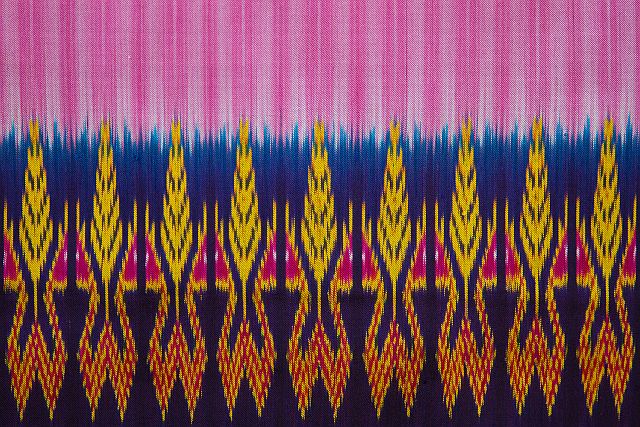
Thai silk sample design  (wikipedia)


Appropriately, the Jim Thompson house nestles within a jungle setting along one of Bangkok’s klongs.
In the 21st century, the silk industry of Thailand thrives and the Oriental continues to be one of the finest hotel properties in the world. Thompson’s “House on the Klong” is a major tourist attraction in a region where “disappearing” is not unusual.

At least twelve theories have been offered as a solution to the Thompson mystery, including one that he may even have planned his own disappearance. None has produced a satisfactory answer.

The Jim Thompson mystery remains unsolved and Thai silk continues to be a popular souvenir of Thailand  (wikipedia)

So the mystery of Jim Thompson continues. All you need to do is travel to Southeast Asia and immerse yourself in discovering the answer.

Read more travel and discover tours at:  Magellan Travel Club